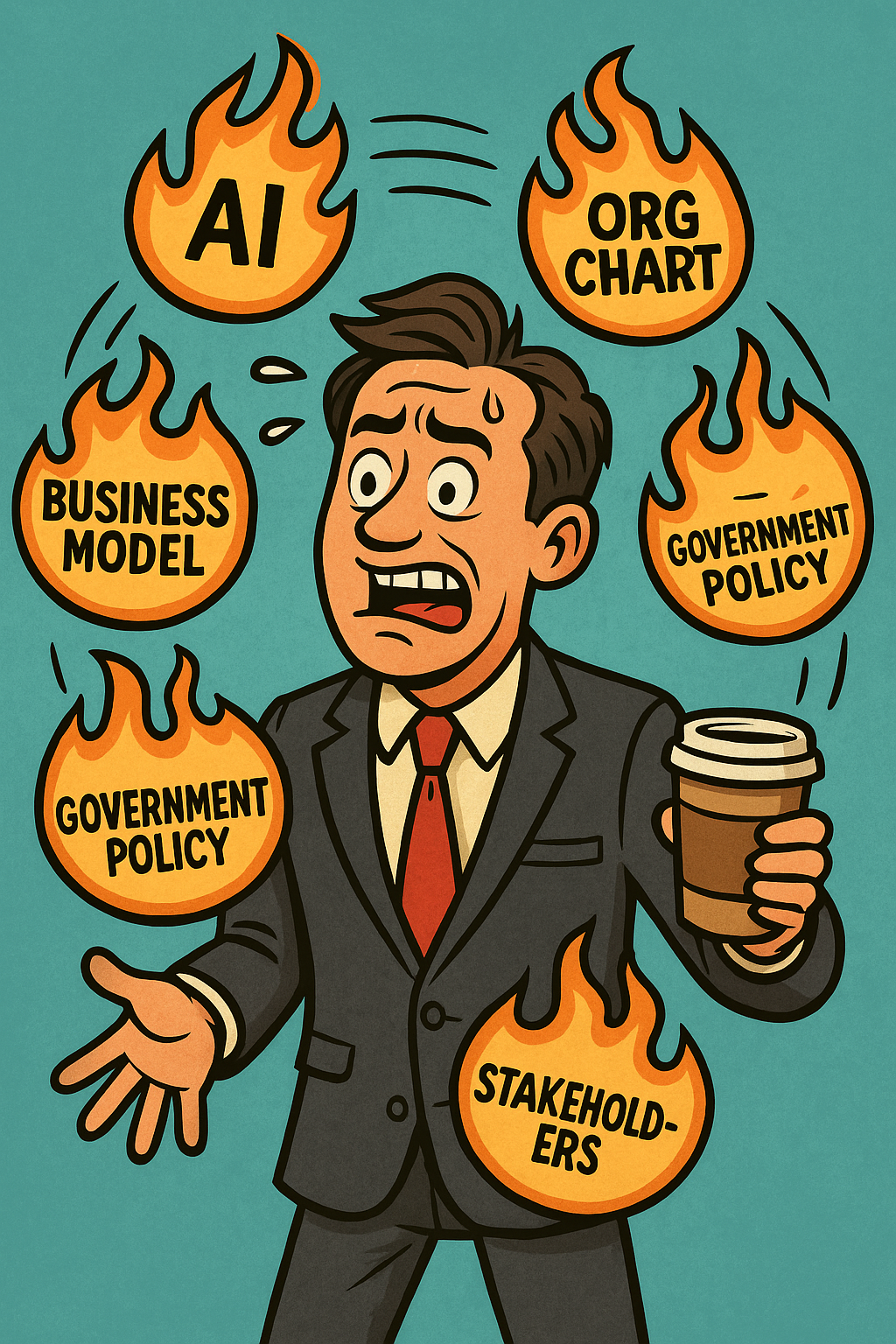
CEO Coaching: Strange Times
 If you’re a CEO right now, you’re probably wrestling with at least five big questions (or “opportunities,” if you’re an optimist—or a masochist):
1. Do I need to reinvent my business model?
2. I know AI is coming for me, but what the hell do I actually do with it?
3. How do I optimize my organizational structure without triggering a mutiny?
4. How do I brace for the government’s next swoop-and-poop policy surprise (tariffs, supply chains, etc.)?
5. How do I meet stakeholder expectations—whatever those are this week?
You can’t eat the elephant all at once, so let’s carve off a few bites.
Business Model: Will AI Eat Your Lunch—or Serve It to You?
How do you profitably serve your chosen market in the future? Will AI replace your revenue stream, or turbocharge it? Can you meet your most profitable customers’ needs better—or differently? If you had to design a company to kill yours, what would it look like?
Business models and strategy are cousins, not twins. You can have the same strategic focus (product, cost, or customer intimacy) but change the way you deliver and monetize value. Conversely, a new business model can make your current strategy irrelevant.
“How do we make a buck?” is not the same as “Why will they buy from us?”
AI: Friend, Foe, or Both?
Ask yourself:
- How can I use AI to serve customers dramatically better?
- How can I use AI to slash costs or cycle times?
- Can it improve problem-solving, eliminate waste, or reduce errors?
Many CEOs I talk to are way behind on these questions. That’s not a “later this year” issue—it’s a now issue. If you’re unwilling to push forward, do your shareholders a favor and take early retirement. And if you care about your coworkers, lead the transition responsibly. Disruption hurts, but denial kills.
Organizational Structure: Is Your Org Chart an Antique?
Your organization should exist to execute your business model and delight customers. If either of those just changed, your org chart is almost certainly wrong.
What roles are irrelevant? What skills are missing? If you started with a blank slate, how would you build a team to win the future?
(Hint: “because we’ve always done it this way” is not an acceptable design principle.)
Government: The New Wild Card
You’ve seen it—supply chains break, policies flip overnight, and the government picks winners and losers like a drunken Vegas dealer. So where are your biggest risks?
Map them on a two-axis chart: likelihood of occurrence vs. negative impact.
- High on both? You’d better have bulletproof plans.
- Low on both? Ignore it.
- The middle? Manage it.
And the low-likelihood/high-impact ones? Those are your “can’t-sleep-at-night” scenarios.
Stakeholders: Shareholders and Employees (a.k.a. The Anxious and the Afraid)
Shareholders (via your board): Many are as dazed and confused as everyone else. The old playbooks don’t work. You may have less guidance—but more freedom—to lead. Scary? Yes. But also liberating, if you’ve got the chops.
Employees: They’re spooked—AI headlines, policy whiplash, economic uncertainty. Frankly, you probably are too. But as the top gun, it’s on you to project clarity, transparency, and a path forward. You don’t need all the answers—just more conviction than panic.
There’s a lot on your plate—perhaps more than ever. So buck up, take a deep breath, and lead. Because “wait and see” is not a strategy—it’s an obituary.

coaches CEOs to higher levels of success. He is a former CEO and has led teams as large as 7,000 people. Todd is the author of, Never Kick a Cow Chip On A Hot Day: Real Lessons for Real CEOs and Those Who Want To Be (Morgan James Publishing).
Connect with Todd on LinkedIn, Twitter, call 303-527-0417 or email [email protected].


